Dr. Robert Jay Lifton
The title of Robert Jay Lifton's autobiography is apt. Witness to an Extreme Century follows the life of an American public intellectual. Dr. Lifton has studied Nazi doctors, Hiroshima, cults, climate change, torture and genocide. He's taught at City University of New York, Yale, Columbia Media Center and Harvard.
Lifton is a sought-after commentator and prolific writer. Explore some of his recent work on NPR's Fresh Air and the Moyers on Democracy podcast.
The story of the creation of the bomb, of the hydrogen bomb and certainly of the Cuban Missile Crisis — has to be retold. Those stories have to be retold for each generation.
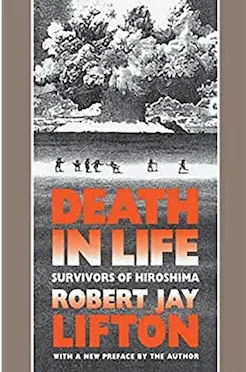
DEATH IN LIFE
Dr. Lifton first worked in Hiroshima as a graduate student in the 1960s — he has returned to it for decades.
The Name of a City
One hears the word and wants to know more, but one also wants to forget it. One has heard both too much and not enough about Hiroshima. For the city evokes our entire nuclear nightmare, and any study must begin with this symbolic evocation.
What Hiroshima does convey to us — indeed press upon us—is the realization that it actually happened and the implication that it could happen again. The mythological metaphors usually employed to suggest this idea—the genie let out of the bottle or Pandora’s box opened—do not seem adequate for this phenomenon…We need new myths to grasp our relationship to the cool, ahuman, completely technological deity which began its destructive reign with Hiroshima.
A sample of other publications by Robert Jay Lifton related to Hiroshima: "Art and the Imagery of Extinction;" "The Age of Numbing;" "Images of Nuclear War and Human Destruction: Psychological Perspectives;" "Nuclearism; "On Death and Death Symbolism: The Hiroshima Disaster;" "The Prevention of Nuclear War;" "Psychological Effects of the Atomic Bomb in Hiroshima;" "The Theme of Death;" "Beyond Nuclear Numbing."
HIROSHIMA IN AMERICA: 50 YEARS OF DENIAL
Written with Greg Mitchell, Hiroshima in America: 50 Years of Denial, detailed the government, media, institutional and psychological influences that has prevented America from fully realizing the world that began on August 6, 1945.
The cumulative influence if Hiroshima is much greater than most Americans suspect. Indeed, one may speak of the bomb’s contamination not only of Japanese victims and survivors, but of the American mind as well.
We have felt the need to avoid at any cost a sense of moral culpability for the act. And there has been a cost, one much greater than we wish to recognize.
“Psychic numbing” an be defined as a diminished capacity or inoculation to feel….
LIFTON ON OPPENHEIMER
His greatest tragedy was the success of his leadership in the creation of the weapon. His remarkable gifts as a physicist and as a human being were most realized in the building of a weapon that could lead to the destruction of humankind. "Oppenheimer's Tragedy and Our Own," Robert Jay Lifton, Bulletin of the Atomic Scientists, July 17, 2023
SURVIVING OUR CATASTROPHES: RESILIENCE AND RENEWAL FROM HIROSHIMA TO THE COVID-19 PANDEMIC
In his latest book Dr. Lifton explores how previous world disasters can provide strategies for dealing with 21st century problems including climate change and the pandemic.
How does the knowledge that we are all survivors of Covid affect our behavior? It could be a step toward channeling the much broader sense of death anxiety in the direction of potential action. It might also help us to cultivate our resilience and under threatening circumstances. Grief and pain, when shared, can become seeds of action.
TALKING WITH DR. LIFTON
Dr. Lifton: America frequently cuts off the past. And she's the president in the future as if it is all pervasive — as though events came from a kind of tabula rasa and nothing had preceded them. That's a kind of general [American] characteristic. Nuclear threat is a very special one.
From the moment of Hiroshima there was a widespread, a collective, sense that this could be world ending. At that time with the atomic bomb, literally, we did not have the technology to end the world. But with the creation of the hydrogen bomb — so many times more powerful, we did have exactly that capacity. That was taken in, but suppressed with a considerable amount of psychic numbing. Or diminished capacity or inclination to feel. But it wasn't eliminated by any means. It simply became outside of awareness.
We require, given the actuality of the situation, a certain amount of nuclear fear. That's appropriate. And when that fear is diminished, suppressed or numbed that further endangers us. There's a taboo against it because of a different dimension. And that's why we need a certain appropriate amount of nuclear fear.
INTV: You use the term nuclear numbing and nuclear normality. Do you feel that the flow of information and the sort of cultural twisting was intentional to create that kind of “Oh, we're afraid, but we're not too afraid.”
Dr. Lifton: They had various groups at one point, even psychiatrists and theologians, who were employed to help reduce American fear of nuclear weapons. That tendency toward psychic numbing would have occurred even in the absence of the cultural or political efforts to reduce nuclear fear.
INTV: I noticed you in your original work with the survivors in the 1960s that essentially they had a permanent encounter with death that most of us don't have and can't really imagine.
Dr. Lifton: I talk about the central role of survivors in helping us to confront and combat catastrophes and I illustrated that in particular with survivors of Hiroshima who became leaders. Survivors are crucial. And I speak of survivor wisdom … the special knowledge [that helps them go] from the helpless victim to the assertive survivor, which can be valuable for dealing with any catastrophe.
INTV: And in HIROSHIMA IN AMERICA: 50 YEARS OF DENIAL, you said we're in some way we’re all survivors of Hiroshima. Do you think that's still true?
Dr. Lifton: It can no longer be pure denial because in some corner of our psyches, at least, there is the recognition of nuclear holocaust as a possibility, the recognition of the weapons as looming large and fraught. [But] we apply considerable psychic numbing tool to it. It can be a loss in subsequent generations of information about nuclear danger and its threat and its history. That threat and history are not eliminated.
In my book, SURVIVING CATASTROPHES, there is a hopeful possibility — by no means definite, but hopeful. That there can be what I call survivor legacy, meaning that the survival …legacy can be transmitted over generations.
INTV: How can we make sure that we have an active cultural memory that is useful to us? That's not just a spin job? Or is that even possible?
Dr. Lifton: Well, we can't make sure of it. But we can do things to encourage it and. That involves recognizing it has become necessary.
I say it's become necessary because of threats by Putin. We suspect that Putin recognizes the danger of what we used to call a nuclear end or the destruction of the species. But he threatens and therefore has recognized the taboo. But he threatens to violate or overcome the taboo.
INTV: Which, then I guess is making use of the fear – having this fear rise again.
Dr. Lifton: It's not just Putin, but America as developed so-called modernization of nuclear weapons, which really means rendering them smaller and more efficient… therefore more usable. And, we also have other nuclear weapons possessors such as India and Pakistan The danger is real and therefore we have to be aware of it.
The story of the creation of the bomb, of the hydrogen bomb and certainly of the Cuban Missile Crisis — has to be retold. Those stories have to be retold for each generation.