Glossary
Soon after the bomb changed the world forever, the international community began to grapple with where to head next. By January of 1946 the United Nations was in full debate-mode. The Truman administration created an advisory committee to study the atomic issue. What was known as The Acheson-Lilenthal report proposed an international compact that required a high level of cooperation between the U.S and the U.S.S.R. The day before the report was due to be released Truman’s newly-appointed delegate to the United Nations Atomic Energy Commission, Bernard Baruch presented a plan that called for a virtual American monopoly on atomic technology. The U.S.S.R. was having none of it.
“We are here to make a choice between the quick and the dead. That is our business.” -Bernard Baruch
In 1944, President Roosevelt and Prime Minister Churchill met at Roosevelt’s home in Hyde Park, New York. During that meeting the two agreed in principle that the technology of the nuclear bomb would remain a secret between the two nations, and importantly:
"The matter should continue to be regarded as of the utmost secrecy; but when a “bomb” is finally available, it might perhaps, after mature consideration, be used against the Japanese, who should be warned that this bombardment will be repeated until they surrender.”
Soon after the bomb changed the world forever, the international community began to grapple with where to head next. By January of 1946 the United Nations was in full debate-mode. The Truman administration created an advisory committee to study the atomic issue. What was known as The Acheson-Lilenthal report proposed an international compact that required a high level of cooperation between the U.S and the U.S.S.R. The day before the report was to be released Truman’s newly-appointed delegate to the United Nations Atomic Energy Commission, Bernard Baruch presented a plan that called for a virtual American monopoly on atomic technology. The U.S.S.R. was having none of it.
“We are here to make a choice between the quick and the dead. That is our business.” -Bernard Baruch
The Bravo test winds spread radioactive particles east, affecting several inhabited atolls, including Rongelap, Utirik and Ailinginae and the U.S. sailors observing the test stationed on Rongerik Atoll. Fallout reached a Japanese fishing boat named Daigo Fukuryū Maru or “Fifth Lucky Dragon,” located 80 miles east of the test site. All 23 members of the crew were exposed to radiation and they brought irradiated fish back to Japan, causing a panic. Castle Bravo brought the term “fallout,” into common use.
"The art or practice of pursuing a dangerous policy to the limits of safety before stopping, especially in politics. The term derives from an interview in 1956 with the American international lawyer and politician John Foster Dulles (1888–1959), in which he said, ‘The ability to get to the verge without getting into the war is the necessary art…We walked to the brink and we looked it in the face.’"
The political tactic known at "containment" — first articulated by George Kennan, was the main policy of the Truman administration. In short, it called for the U.S. to counter expansion of communism in any part of the world. "The adroit and vigilant application of counter-force at a series of constantly shifting geographical and political points, corresponding to the shifts and maneuvers of Soviet policy.” The Cuban Missile Crisis, Vietnam and Korea Wars illustrate the policy.
The Comprehensive Nuclear-Test-Ban Treaty (CTBT) bans all nuclear explosions, whether for military or peaceful purposes. The Preparatory Commission for the Comprehensive Nuclear-Test-Ban Treaty Organization works toward adding national signatories — 177 of 196 nations have ratified the treaty. The United States is a signatory but has not ratified the treaty.
President Truman created the CONELRAD [CONtrol of ELectronic RADiation] in 1952. CONELRAD broadcast emergency alerts to the public. Dedicated radio frequencies were set at 640/1240 kHz. All radios manufactured after 1953 marked the positions on their dials.
"Defense readiness conditions" (DEFCONs) describe progressive alert postures primarily for use between the Joint Chiefs of Staff and the commanders of unified commands."
In foreign policy, deterrence is a strategy for maintaining peace by persuading enemies that any attack will be met with a significant response.
For deterrence to work, two conditions should be present: severity and credibility.
Severity entails threatening a prospective opponent with a retaliation that would outweigh any potential benefits they could hope to gain from attacking...
Credibility means making an opponent believe that further aggression on their part will provoke retaliation.
Downwinders is the term used for people who have been exposed to nuclear fallout — in the American Southwest, the South Pacific and waste storage areas, for example.
Attorney Tom Foulds represented plaintiffs, or Downwinders, in the Hanford Nuclear Reservation Litigation. In this interview, Foulds recalls the decades-long battle to win compensation.
Currently, the Health and Resources Administration runs a compensation program for "downwinders." Conditions that can earn compensation include: .
- Leukemia, but NOT chronic lymphocytic leukemia
- Multiple myeloma
- Primary cancer of the pharynx
- Lymphomas, other than Hodgkin's disease
- Primary cancer of the small intestine
- Primary cancer of the salivary gland
- Primary cancer of the brain
- Primary cancer of the stomach
- Primary cancer of the urinary bladder
- Primary cancer of the colon
- Primary cancer of the thyroid....
A no-first-use nuclear policy means that the United States would commit to never being the first nation to use nuclear weapons in any conflict, a change from its current policy.
"The classified document was submitted to the Interim Committee, a group appointed by President Truman to advise him on the use of the bomb, in June 1945, one month before the Trinity test and two months before Hiroshima and Nagasaki. While the scientists agreed that the development of nuclear power constituted an important addition to the technological and military power of the United States, it also created, in their words, “grave political and economic problems for the future.” Consequently, they advised against an attack on Japan because:
if the United States were to be the first to release this new means of indiscriminate destruction upon mankind, she would sacrifice public support throughout the world, precipitate the race for armaments and prejudice the possibility of reaching an international agreement on the future control of such weapons.
The Franck Report became the seminal document on nuclear arms control after a declassified version was published in the May 1, 1946 issue of the Bulletin of the Atomic Scientists. Principally written by Bulletin co-founder Eugene Rabinowitch, the report predicted the impossibility of keeping the (secret) nuclear genie in the bottle."
Prominent nuclear scientists did not recommend the atomic bombings of Japan, Bulletin of the Atomic Scientists
"Atomic Bomb survivors are referred to in Japanese as hibakusha, which translates literally as “bomb-affected-people”. According to the Atomic Bomb Survivors Relief Law, there are certain recognized categories of hibakusha: people exposed directly to the bomb and its immediate aftermath; people exposed within a 2 kilometer radius who entered the sphere of destruction within two weeks of the explosion; people exposed to radioactive fallout generally; and those exposed in utero, whose mothers were pregnant and belonging to any of these defined categories."
In 1955, a group of young women with keloid scars were brought to the U.S. for plastic surgery. They embarked on carefully scripted goodwill tour and their “before and after” images were everywhere in national media.
"Caring for the Hiroshima Maidens," Bulletin of the American College of Surgeons
John Wayne was oddly cast at Genghis Kahn in the 1956 film The Conqueror. The set was in the nuclear test area and soon rumours of a atomic curse surfaced. A 1980 People magazine contended that “Of The Conqueror’s 220 cast and crew members from Hollywood, an astonishing 91 have contracted cancer.”
The 1959 Kitchen Debate was a perfect example of sublimation. Vice President Richard Nixon and Nikita Khrushchev had a heated argument about whether capitalism or communism provided citizens the best kitchen.
Diplomat George Kennan sent an 8000 word telegram to the Secretary of State which directed U.S foreign policy for decades. Kennan warned:
"[The] problem of how to cope with [the Soviet] force in [is] undoubtedly greatest task our diplomacy has ever faced and probably greatest it will ever have to face. It should be point of departure from which our political general staff work at present juncture should proceed."
Making sure that the U.S.S.R. did not help spread communism any further in the world became the guiding policy of “containment.”
In 1962, the concept of mutually assured destruction (MAD) started to play a major part in the defence policy of the U.S. President Kennedy's Secretary of Defense, Robert McNamara, set out in a speech to the American Bar Foundation.
McNamara proposed a doctrine of “assured destruction” made manifest by the strength of weapons power. Any attack would assure annihilation of the attacking country. McNamara posited that this prospect of mutual annihilation would serve as an effective deterrent — but it also spawned the arms race as each nation could not fall behind and thus lose the MAD status.
"No Cities" Speech by Sec. of Defense McNamara, July 9, 1962
Massive retaliation was the foreign policy of the Eisenhower administration. Designed by Secretary of State John Foster Dulles, the policy "called for the development of technology necessary to match and even surpass Soviet nuclear capabilities." Eisenhower's great reluctance to engage in such high-stakes conflicts led to a series of "proxy wars."
Nuclear winter serves as the backdrop to many post-apocalyptic films. Famed, and extremely popular, scientist Carl Sagan used the term in 1983 in a Parade Magazine article. The magazine cover pulled no punches:
"The story detailed the previously unexpected consequences of nuclear war: prolonged dust and smoke, a precipitous drop in Earth's temperatures and widespread failure of crops, leading to deadly famine. "In a nuclear 'exchange,' more than a billion people would instantly be killed,” read the cover. “But the long-term consequences could be much worse...""
Shortly after the bombings of Japan, scientists, many of those who had been involved with the development of the bomb, began to express grave concerns to the public, government and international bodies. In July, 1955 two of the most famous names in the world, Bertrand Russell and Albert Einstein, composed a manifesto - a warning of “universal death” if a strategy of universal peace was not quickly found.
“In view of the fact that in any future world war nuclear weapons will certainly be employed, and that such weapons threaten the continued existence of mankind, we urge the governments of the world to realize, and to acknowledge publicly, that their purpose cannot be furthered by a world war, and we urge them, consequently, to find peaceful means for the settlement of all matters of dispute between them.”
The manifesto was signed by a number of notable scientists and inspired the creation of the Pugwash Conferences on Science and Public Affairs.
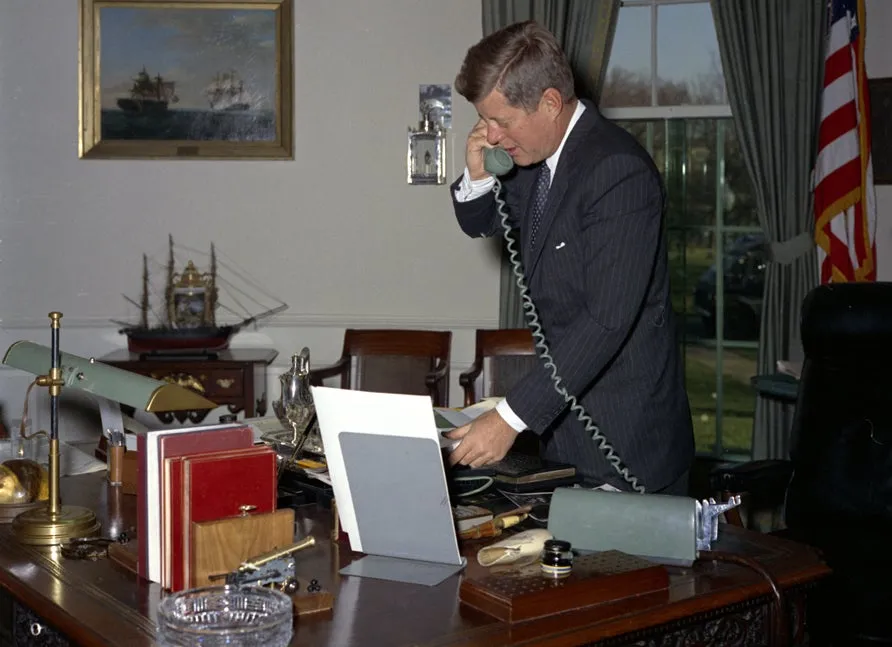
Although a red telephone has appeared in countless movies, there has never been a red telephone in the White House. Also a myth, the red button. But after the Cuban Missile Crisis a hotline between the White House and the Kremlin was established.
"There Never Was Such a Thing as a Red Phone in the White House," Smithsonian magazine, June 2013
The Moscow-Washington red phone wasn't red and wasn't a phone, VOX news, August 30, 2015.
Soviet space achievements ratcheted up the heat in the Cold War. On October 4,1957, the U.S.S.R. launched sputnik — the first artificial satellite.
"A Blow to the Nation," PBS NOVA "Sputnik Nation"
Ronald Reagan’s 1983 Strategic Defense Initiative speech, commonly known as the “Star Wars” speech, initiated a massive new military program. Included was a plan to create a space-based system to stop nuclear weapons using laser technology.
"The Treaty between the United States of America and the Russian Federation on Measures for the Further Reduction and Limitation of Strategic Offensive Arms, also known as the New START Treaty, enhances U.S. national security by placing verifiable limits on all Russian deployed intercontinental-range nuclear weapons. The United States and the Russian Federation have agreed to extend the treaty through February 4, 2026."
Russian President Vladimir Putin said on February, 21, 2023 that he was suspending Russian participation in the treaty.
When requesting funding to support for Greece and Turkey: President Truman declared, "It must be the policy of the United States to support free peoples who are resisting attempted subjugation by armed minorities or by outside pressures."
The Truman Doctrine spawned the "domino theory" in pursuit of proxy wars.
Council on Foreign Relations on the Truman Doctrine
When signing the Intermediate Range Nuclear Forces Treaty in 1987, President Reagan first used the phrase "trust but verify"— a common expression in Russian — in relation arms agreements.
The question of whether or not the United States leaflets on Hiroshima and Nagasaki warning of a coming bombing event is still open — and still very contentious.
Official Report on the Bombing of Hiroshima and Nagasaki