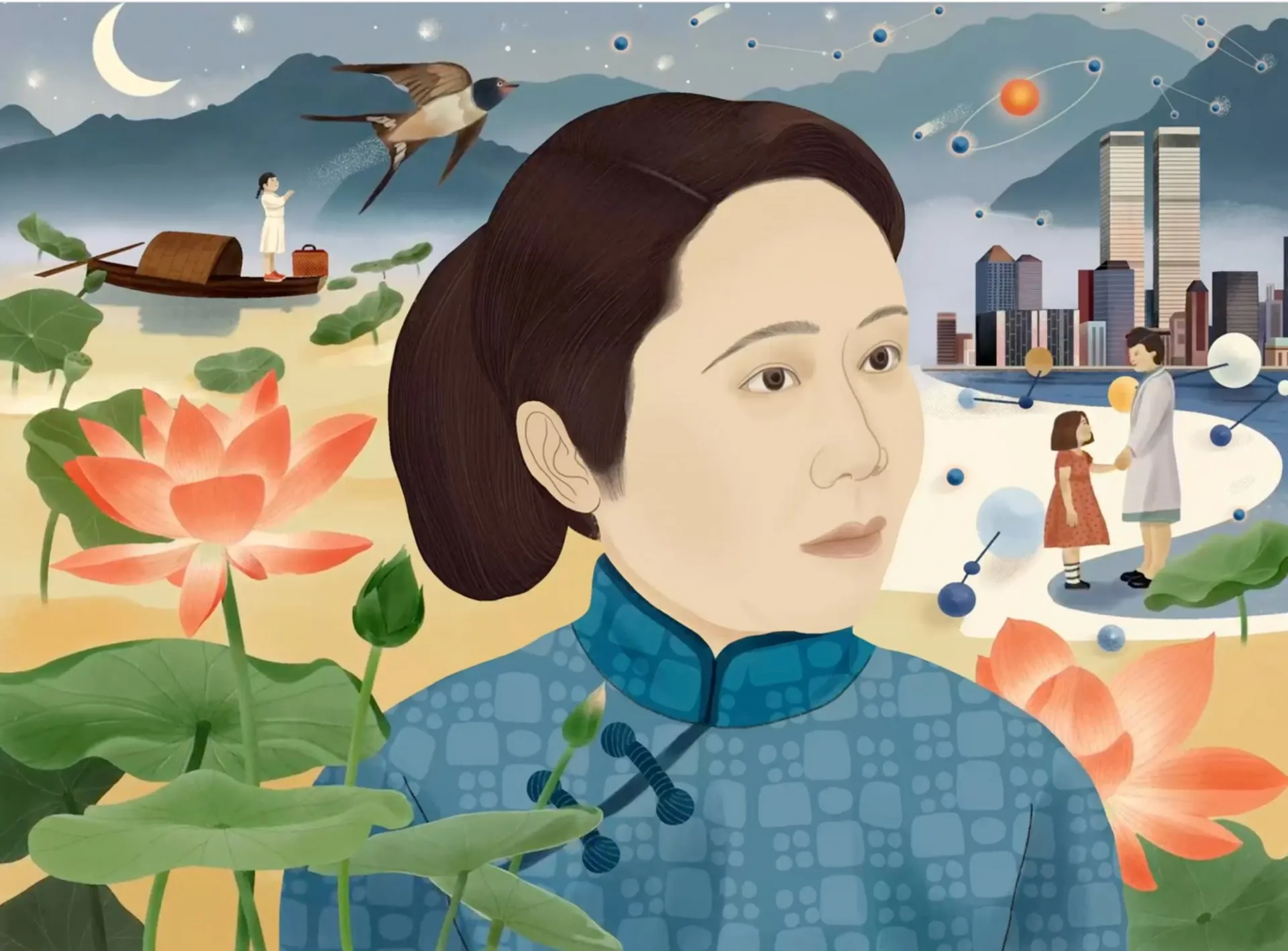
Madame C.S. Wu
Chien-Shiung Wu, commonly known as Madama C.S. Wu, came to Columbia University in 1944 to work on The Manhattan Project — she didn't leave until her retirement in 1981.
Born in 1912, Chien-Shiung grew up in a small town north of Shanghai. Thanks to the support of her father, she got an university education. She earned a physics degree from the National Central University in Nanking.
Another woman physicist, Dr. Jing-Wei Gu, encouraged Chien-Shiung to further her education in the United States. Chien-Shiung entered the U.S. in the San Francisco area (probably through the Angel Island Immigration Station.)
She studied under Ernest Lawrence, who won the Nobel Prize in Physics in 1939 during her time at Berkeley. Lawrence's invention, the cyclotron particle accelerator, played a large part in Chien-Shiung;s career.
MANHATTAN PROJECT
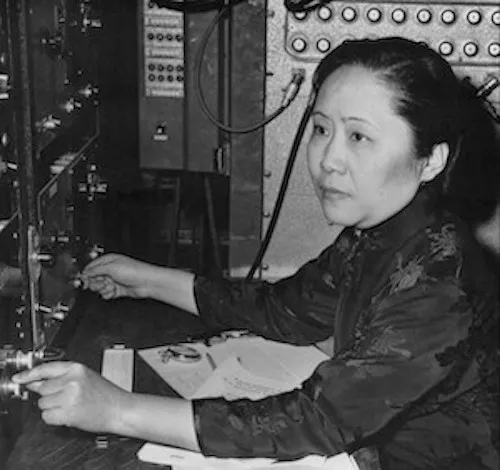
In 1944, one of the few women and only Asian physicist on the top secret project, Chien-Shiung Wu's Manhattan Project work included and radiation detection technology.
The Columbia University arm of Manhattan Project had already moved physics (and eventually the atomic bomb) forward. The Columbia Archives has a first-person account of the night in January, 25,1931: “Believe we have observed new phenomenon of far-reaching consequences.” The group witness nuclear fission in the cyclotron in the basement of Pupin Hall and provided more evidence for the possibility of nuclear chain reaction..
When Chien-Shiung Wu joined in the group in 1944 she worked on uranium enrichment and on improving the crucial technology of the geiger counter.
RESEARCH
Chien-Shiung Wu is one of the many women "Overlooked for the Nobel Prize"
According to the Columbia University Physics Department:
Her most definitive achievement, however, was her 1956 experiment that disproved the "law of parity conservation,” once considered an immutable law of physics. This discovery, lauded as one of the most important developments in the field of atomic and nuclear physics, established that the laws of nature are not always symmetrical.
Brian Greene, professor of physics and mathematics at Columbia, said Wu’s discovery that some events in nature can violate parity conservation, as the mirror symmetry is known, stunned physicists and played a crucial role in the advancement in atomic science.
“After Madame Wu’s experiment, we had to discard completely the idea that the universe is mirror symmetric,” Greene said. “Only a handful of physicists have made contributions that have radically changed our perspective on reality, and she is one of them.”
Wu’s groundbreaking work resulted in the 1957 Nobel Prize for Tsung-Dao Lee and Chen Ning Yang, colleagues whose theories were validated first by what became known as the “Wu experiment,” but the prize committee did not acknowledge Wu’s work.
PROFESSOR
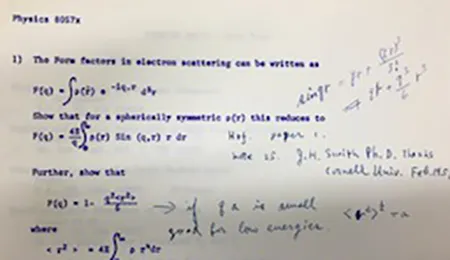
Chien-Shiung Wu taught at Columbia until 1981. Notes from her papers in the Columbia Archives include and carefully corrected exam papers.
In 1967, Madame Wu attended the Conference on Nuclear Structure in Tokyo. In her conference report she recalls giving an interview to the Japanese version of Scientific American:
My only interest is that this interview may give some encouragement to young Japanese girls who are studying in science and arouse the attention of Japanese educators who have long neglected women’s position in the field of science.
ADVOCACY
Professor Wu took the lead in pushing Columbia toward the new world of equal opportunity. In 1972, she headed an ad hoc committee which presented the university administration with a series of demands.
In 1972 there were 11 women on the full-time faculty.
All salaries for minority and women members of the faculties shall be at least equal to those of the male colleagues.
LEGACY
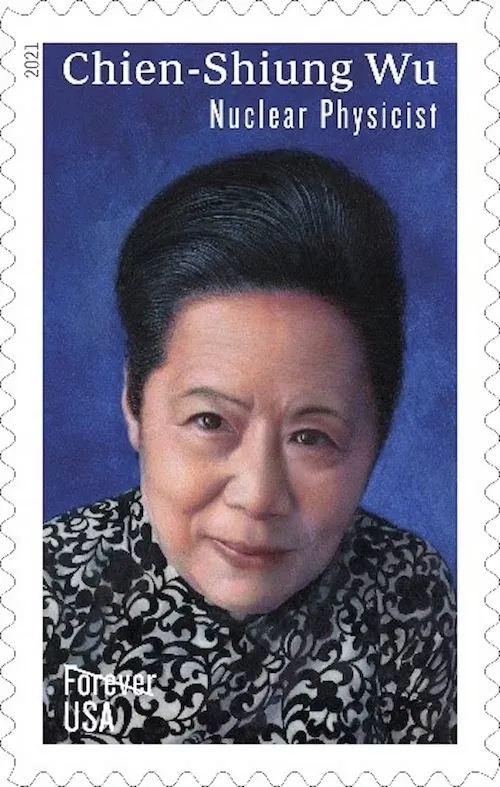
The U.S. Post Office issued a stamp of Madame Wu to mark International Day of Women and Girls in Science 2021.
Again from the Columbia University Physics Department:
Nowhere was Wu more acclaimed than in China, where she was considered a heroic national treasure. (In Chinese, Chien-Shiung means courageous hero.) In 1990, an asteroid discovered by astronomers at the Zijinshan Astronomical Observatory in Nanjing was named the 2752 Wu Chien-Shiung in her honor.
A GRANDDAUGHTER'S STORY
Jada Yuan explore the story of the woman who was grandma to her and a ground-breaking nuclear physicist to the world at large.